
Most designers, creatives, and service-based brands don’t struggle because their work isn’t good. They struggle because their audience doesn’t know what they really do, or why it matters.
That’s where your signature message comes in. It’s the core idea you want people to know, feel, and repeat about your brand. It shows up in your conversations, your sales pages, your Instagram bio, your proposals. And you typically have just 20 seconds or less to make someone care.
Key Takeaways
- Your signature message should communicate what you do, why it matters, and who it’s for… in 20 seconds or less.
- Strong brand messaging includes short-form, situational, and story-based expressions that work across platforms.
- You don’t need “one message”, you need a message system rooted in clarity, connection, and repetition.
What Is a Signature Message?
Your signature message is the foundation of your brand communication. It’s not just a single sentence, it’s the system of language that helps your audience instantly understand:
- Who you serve
- What transformation you deliver
- Why you’re different
- Why it matters right now
Think of it as your “why you” message. It’s the throughline that runs through your content, pitches, social media, website, and live conversations. It can take the form of:
- A one-liner for fast intros. Here’s a simple brand message formula!
- A brand bio or sales page statement
- A short narrative that creates emotional connection
- Repeatable phrases and themes that reinforce your positioning
Why It Needs to Be More Than One Line
We all love a punchy, shareable brand statement. But here’s the truth: no one line can fully express what your brand stands for. That’s why we teach brands to build message systems, not just slogans.
Your signature message needs to flex across formats:
- Short version: “I help [who] do [what] so they can [result].”
- Bio version: “I’m a [title] helping [audience] achieve [transformation] through [signature approach].”
- Story version: The deeper why that connects your lived experience to the work you do today.
Different contexts call for different expressions but they all need to connect back to the same core truth.
Use the Signature Story Framework
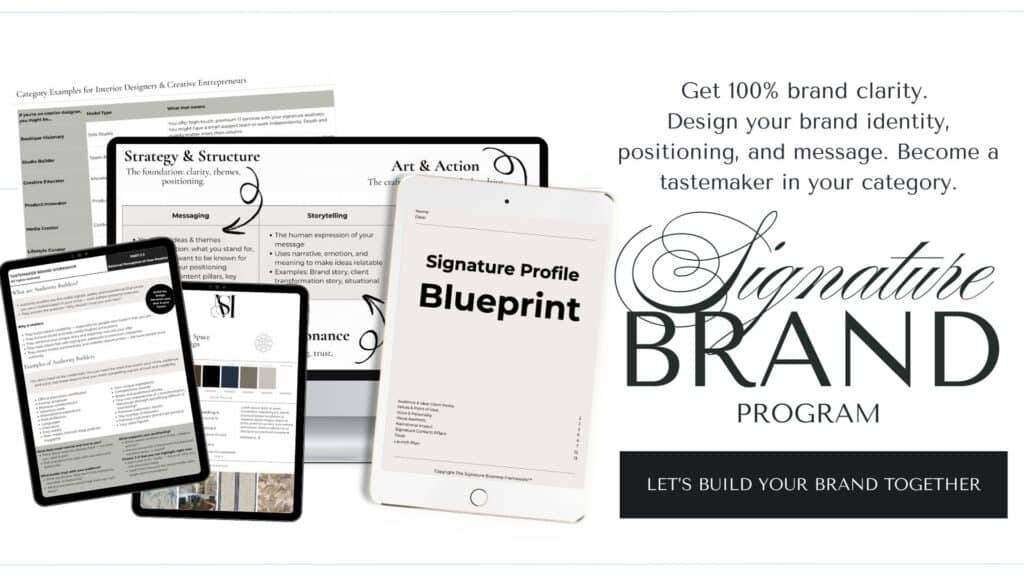
There isn’t just one way to tell your story. Inside the Signature Brand workshops, we teach multiple story frameworks – each designed for different types of content, from keynote talks to Instagram captions to portfolio case studies. The key is knowing which story to tell, when, and how deeply to go. Here’s one of the frameworks:
The Signature Story Framework
This four-part model helps you develop the emotional backbone of your brand message:
The Thread
What’s been consistent through everything you’ve done? This could be a value, a design belief, or a way of working that’s never changed.
The Turning Point
When did something shift for you? This is usually a lived experience or decision that clarified what you really care about, and set you on the path you’re on now.
The Why
What matters to you now? Why do you do this work, and why does it feel essential, not just to you, but to the people you serve?
The Now
What do you do today, who do you help, and how is your approach or perspective different?
You can use this structure for your About page, speaking intros, client pitches, or even service page copy. It helps you move beyond generic bios and toward messaging that feels both grounded and magnetic.
Message vs. Story: You Need Both
Your message explains what you do and why it matters. Your story makes it real. The message gets attention. The story builds trust. Together, they answer:
- What do you do?
- Why should I care?
- Who else has done this with you?
Stories bring the message to life. They show how your work has helped real people solve real problems. When someone sees themselves in your story, they’re more likely to believe in your solution. Use both because while clarity draws people in, connection keeps them there.
Building Message Pillars
Your signature message becomes stronger when it’s supported by clear, consistent message pillars – core themes that show what your brand stands for beyond your services. These aren’t taglines but foundational ideas that shape your content, your conversations, and how people describe your work when you’re not in the room.
Effective message pillars do three things:
- Reflect your values and beliefs
- Reinforce your expertise and method
- Connect emotionally with the people you serve
Here’s how they might sound in practice:
- Design shapes behavior: The spaces we live and work in influence how we feel, think, and move through the world.
- Your home should support your life, not just impress others: Beautiful design is only meaningful when it’s livable.
- Refinement isn’t about perfection, it’s about intention: Great design isn’t loud. It’s layered, thoughtful, and deeply personal.
Once you’ve defined your pillars, use them everywhere. They become the backbone of your content strategy, your sales copy, and your brand voice. Repetition is what makes your message memorable.

Your signature message isn’t something you write once and forget. It’s a living system that evolves as your business deepens. It shows up in what you say, how you present your offers, the stories you tell, and the language your audience starts repeating back to you.
If your message still feels vague or overly clever, simplify it. Make it clearer. Then, add the emotional weight that only your story can bring. Let people see not just what you do, but what you believe. Let them feel the difference.
And when someone asks, “What do you do?” – you’ll have more than a title. You’ll have a message that lands, a story that resonates, and a voice that leads.
That’s what makes it stick. That’s what makes it yours.